
Major
Mathematics
The Mathematics program is part of the Division of Mathematics and Natural Sciences of the College of Arts and Sciences. This program is designed to promote critical thinking and analytical reasoning and to prepare students for mathematical careers in business, government, teaching, and industry.
Mathematics Placement and Pathways
The University uses ACT test results, SAT test results, an evaluation of high school transcripts and GPA, or an in-house placement exam for placing students in mathematics courses. The pathways chart below provides placement information for mathematics courses for which an ACT or SAT test score is provided. If an ACT or SAT test score is not provided, an evaluation of high school transcripts and associated GPA in mathematics courses, or score on a placement exam will provide information for mathematics placement
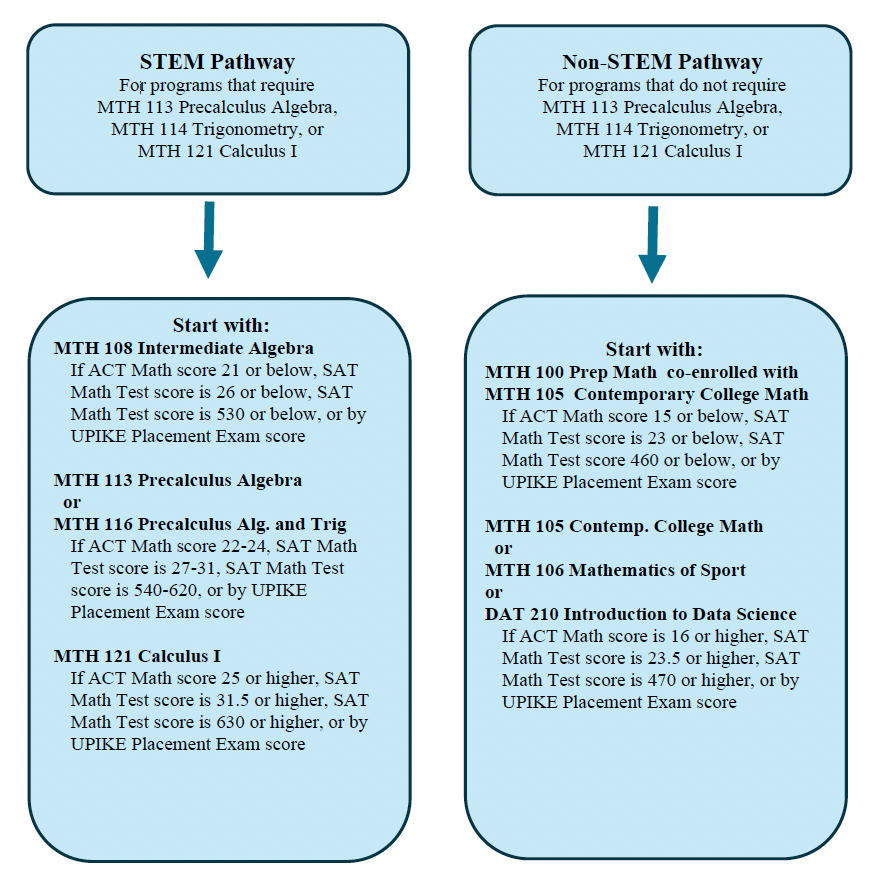
Teaching Certification in Mathematics also available: See Education.
Degrees
Courses
MTH-100: Preparatory Mathematics
Credits 1In this course, students will develop the basic numeration and computation skills needed for more complex mathematics. Topics may include: positive and negative number, exponents, order of operations, fractions, word problems, equations, and polynomials. The course consists of web-based activities such as embedded tutorials, practice exercises, multimedia aids, and other resources to enhance basic mathematical skills. This course will be graded on Pass/Fail basis. Corequisite: MTH 105.
MTH-105: Contemporary College Mathematics
Credits 3The goal of this survey course is to develop competence in analytical reasoning, problem solving, and multi-step decision making as well as exposing students to some current trends in mathematical thought. The emphasis is on mathematical reasoning and the solving of real-life problems involving mathematics. The course covers counting techniques and probability, topics in geometry, and financial/consumer mathematics. Additionally, one to three of the following topics will be covered: graph theory, logic/set theory, linear programming, game theory, or elementary number theory. Three hours of lecture and up to one hour of additional recitation per week. Prerequisite or Corequisite: MTH 100 or placement beyond. This course does not count for any math or natural science major or minor program. This course fulfills the Mathematics requirement in the General Education Curriculum.
MTH-106: Mathematics of Sport
Credits 3In this course, students will learn about mathematics in a wide variety of Olympic and non-Olympic sports. Basic computations include QB rating in football, scoring in bowling, games behind in basketball and baseball, and plus-minus in hockey. Sports trends like discus throw distance and basketball scoring after the shot clock was instituted are investigated, with Excel plots of such data and calculation of a regression line. Comparative analyses of sports for home advantage, professional speeds achieved by balls, pucks, and other objects, and sizes of playing fields and equipment are made. The Excel spreadsheet is used, but previous work with Excel is not required. The course fulfills the Mathematics requirement in the General Education for non-education majors. Cannot be used for the General Education math requirement for education majors.
MTH-108: Intermediate Algebra
Credits 3This course is designed to give students the basic algebra concepts to be successful in future math courses. This class includes algebra techniques, problem-solving, studies in linear equations, inequalities, and the operations of different expressions to gain the skills needed to solve equations and develop skills needed to study basic functions. This course fulfills the Mathematics requirement in the General Education Curriculum.
MTH-113: Precalculus Algebra
Credits 3Further study of topics in algebra, including linear and quadratic equations; functions, relations, and their graphs; polynomials and rational functions; exponentials and logarithmic functions; systems of linear equations; and applications. Prerequisite: MTH 108; a math ACT score of 22 or higher; or placement by examination. This course fulfills the Mathematics requirement in the General Education Curriculum.
MTH-114: Trigonometry
Credits 3A study of concepts and applications of circular and trigonometric functions including identities, graphs, and inverses of trigonometric functions; circular motion; solutions of triangles and trigonometric equations; vectors and components; and polar coordinates. Three hours of lecture and up to one hour of additional recitation per week. Prerequisites: MTH 113; a math ACT score of 22 or higher; or placement by examination.
MTH-115: Fundamentals of Geometry
Credits 3A study of plane and solid geometry, including properties of triangles, quadrilaterals, regular polygons, and circles, and congruence, similarity, area, volume, and transformations and symmetry. Prerequisite: MTH 105 or placement by beyond.
MTH-116: Precalculus Algebra and Trigonometry
Credits 5This is a combined course of precalculus algebra and trigonometry. The course emphasizes problem-solving, analytical thinking, and real-world applications of mathematical concepts. Students will engage in mathematical modeling and apply mathematical concepts to real-world situations. Further study of topics in algebra including: linear and quadratic equations; functions, relations and their graphs; polynomials and rational functions; exponentials and logarithmic functions; systems of linear equations. A study of concepts and applications of circular and trigonometric functions, including identities, graphs, and inverses of trigonometric functions, circular motion, solutions of triangles and trigonometric equations, vectors and components, and polar coordinates. This course fulfills the Mathematics requirement in the General Education Curriculum. Prerequisite: MTH 108; a math ACT score of 22 or higher; or placement by examination.
MTH-121: Calculus I
Credits 4A study of functions, including exponential and logarithmic functions, limits and continuity, derivatives, indeterminate forms, and an introduction to indefinite and definite integrals. Applications to finding tangent lines, solving maximum and minimum problems, solving related rate problems, and finding areas and Riemann sums Four hours of lecture and up to one hour of additional recitation per week. Prerequisites: MTH 113 and MTH 114 or MTH 116 or ACT Score of 25 or higher or placement by examination. This course fulfills the Mathematics requirement in the General Education Curriculum.
MTH-200: Elementary Probability and Statistics
Credits 3A study of the basic concepts of probability and statistics including permutations, combinations, binomial distributions, and standard deviations, with emphasis on interpretations and hypothesis testing. Prerequisite: MTH 105, MTH 106, MTH 108, MTH 113, MTH 116, or MTH 121. Cannot be used for the Mathematics Minor.
MTH-222: Calculus II
Credits 4A study of applications of the integral to finding volumes, arc lengths, surface areas, and centroids, techniques of integration, infinite sequences and series, Taylor series. A computer algebra system may be used. Four hours of lecture and up to one hour of additional recitation per week. Prerequisite: MTH 121.
MTH-251: Discrete Mathematics
Credits 3A study of the elements of sets, set operations, mathematical induction, basic counting techniques, and recurrence relations. Prerequisite: MTH 113 or higher.
MTH-281: Basic Mathematics of Maps, Puzzles, and Games
Credits 1A basic investigation of mathematics of basic map projections and travel itineraries; familiar puzzles such as Sudoku, the traingular peg puzzle, Rubik's Cube, and jigsaw puzzles; and board games such as Yahtzee, Risk, Monopoly, and others. Students demonstrate the solving of the Rubik's Cube using open notes as well as the other puzzles. Meets with MTH 481. Prerequisite: MTH 105, MTH 113, or MTH 121. Cannot be taken if student has already passed MTH 481. May fulfill requirements for the Mathematics minor, but not the Mathematics major.
MTH-282: Basic Mathematics of TV Shows
Credits 1An investigation of basic math topics in past and contemporary television shows and episodes. Topics may include basic mathematics used by Charlie Eppes in the TV Show NUMB3RS as he assists the FBI in solving crimes, as well as basic mathematics in specific episodes of Futurama, The Big Bang Theory, The Price is Right, and other shows. Students also identify and discuss key math ideas present in episodes and give a final presentation based on a basic math idea from any television show episode. Meets with MTH 482. Prerequisite: MTH 105, MTH 113, or MTH 121. No credit for students with credit in MTH 482. May fulfill requirements for the Mathematics minor but not the Mathematics major.
MTH-290: Special Topics
Credits 1 4A study of a selected topic of special interest. The topic may differ each time the course is offered and may be proposed by either the instructor or by the student. May be taken for credit any number of times, provided a different topic is offered each time. Prerequisite: Consent of Instructor.
MTH-299: Directed Study
Credits 1 3Individual basic study of a selected topic in mathematics, under the direction of a member of the faculty. Normally open only to students who have completed all regularly offered courses in the mathematics major. Prerequisites: Consent of the Instructor, Division Chair, and Dean of the College of Arts and Sciences.
MTH-303: Introduction to Abstract Mathematics
Credits 3An introduction to abstract mathematics and proofs by means of a study of selected topics in elementary number theory. Prerequisite: MTH 222 or a prerequisite of MTH 251 and a corequistite of MTH 222.
MTH-305: History of Mathematics
Credits 3A chronological presentation of the development of the science of mathematics, with emphasis placed on the significant problems, inconsistencies, and discoveries that led to the growth of the field of mathematics. Prerequisite: MTH 321.
MTH-307: Complex Variables
Credits 3Functions, limits, continuity, differentiation, and integration of functions of a complex variable are examined. Also, contour integration and applications to physics and mechanics are presented. Prerequisite: MTH 321.
MTH-320: Introduction to Numerical Methods
Credits 3Algorithms for the solution of numerical problems implemented on micro-computers; includes discussion of error, polynomial interpolation, solution of nonlinear equations, and numerical integration. Prerequisite: MTH 222.
MTH-321: Calculus III
Credits 4A study of parametric and polar coordinates, vectors in the plane, algebra and calculus on curves and surfaces in space, spherical coordinates, partial derivatives, and multiple integrals, and one or more of the following theorems: Green's theorem, Stokes theorem, and divergence theorem. A computer algebra system may be used. Four hours of lecture and up to one hour of additional recitation per week. Prerequisite: MTH 222.
MTH-322: Differential Equations
Credits 3A study of simple types of ordinary differential equations of various orders and their algebraic and geometric solutions, Laplace transforms, systems of differential equations, and applications. Prerequisite: MTH 222.
MTH-326: Probability and Statistics for Scientists and Engineers
Credits 3This calculus-based course will include methods in enumeration, discrete and continuous random variables; conditional and independent probability; mathematical expectation, mean, variance and standard deviation; distributions and hypothesis testing. Prerequisite: MTH 121. Recommended Co/Prerequisite: MTH 222.
MTH-335: Linear Algebra
Credits 3A study of vector spaces, linear equations, linear transformations, matrices, determinants, and geometric applications of these concepts. Prerequisite: MTH 222.
MTH-400: Advanced Geometry
Credits 3A study of advanced topics in plane and solid geometry. Topics may include, but are not limited to, methods of proof, constructions, loci, elementary transformations, introduction to non-Euclidean geometry, and introduction to projective geometry. Prerequisite: MTH 303.
MTH-410: Abstract Algebra
Credits 3A study of abstract binary operations, groups, rings, and fields. Prerequisite: MTH 303 or consent of the Instructor.
MTH-481: Advanced Mathematics of Maps, Puzzles, and Games
Credits 1An advanced investigation of mathematics of basic map projections and travel itineraries; familiar puzzles, such as Sudoku, the triangular peg puzzle, Rubik's Cube, and jigsaw puzzles; and board games such as Yahtzee, Risk, Monopoly, and others. Students demonstrate the solving of the Rubik's Cube from memory as well as the other puzzles. Meets with MTH 281. Prerequiste: MTH 222. No credit for students with credit in MTH 281.
MTH-482: Advanced Mathematics of TV Shows
Credits 1An investigation of advanced math topics in past and contemporary television shows and episodes. Topics may include basic mathematics used by Charlie Eppes in the TV show NUMB3RS as he assists the FBI in solving crimes, as well as basic mathematics in specific episodes of Futurama, The Big Bang Theory, The Price is Right, and other shows. Students also identify and discuss key math ideas present in episodes and give a final presentation based on an advanced math idea from any television show episode. Meets with MTH 282. Prerequisite: MTH 222. No credit for students with credit in MTH 282.
MTH-490: Special Topics
Credits 1 4A study of a selected topic of special interest. The topic may differ each time the course is offered and may be proposed by either the Instructor or by students. Prerequisite: MTH 321
MTH-495: Seminar in Mathematics
Credits 3Study of a variety of mathematical topics of interest to instructor and students, with active student participation emphasized. Prerequisites: Senior standing, Mathematics major, and consent of the Instructor.
MTH-499: Directed Study
Credits 1 3Individual advanced study of a selected topic in mathematics, under the direction of a member of the faculty. Normally open only to students who have completed all regularly offered courses in the mathematics major. Prerequisites: Consent of the Instructor, Division Chair, and Dean of the College of Arts and Sciences.
MTH-ELEC: Math 300-400 Elective
Credits 3Please plan credits to fulfill a total of 9 hours of electives from Mathematics at 300-400 levels. Once you have added this course to your plan, delete this placeholder by clicking the X.
MTH-ELEC2: Math 200-400 Elective
Credits 3Please plan credits to fulfill a total of 6 hours of electives from Mathematics at 200-400 levels. Note: MTH 200 Elementary Probability and Statistics cannot be used to fulfill a Math Minor requirement. Once you have added this course to your plan, delete this placeholder by clicking the X.
MTH-OR: Mathematics Either/Or
Credits 3Please plan to take CS 222 or PHY 223. Once you have added this course to your plan, delete this placeholder by clicking the X.
MTH-REQ: Math Requirement
Credits 3General Education Curriculum Mathematics requires one course from the following: MTH 105 Contemporary Math, MTH 113 Precalculus Algebra, or MTH 121. Once you have added this course to your plan, delete this placeholder by clicking the X.
MTH-STA: Statistics Requirement
Credits 3Plan MTH 200 or SSC 285. Once you have added this course to your plan, delete this placeholder by clicking the X.